Live with a dog or want to? Do yourself, and the dog, a huge favor and find out what’s in it. Purebred or mixed-breed, there’s hundreds of years of genetics involved that can make or break a family. In short, there’s a lot going on in your dog.
I know. As someone who lives with dogs, writes about the human-animal bond, and works as an animal communicator, I know that most of the enchantment and heartbreak of living with dogs comes down to their breeding.
Yes, you want a healthy dog, no question. And no, I don’t care where you go to get one (I do, but I won’t get into that now). What I want, and I know you want, is to get a dog that suits your lifestyle. Well, guess what? Your dog wants the same thing. And needs it, to stay in the happy home you’re creating for it.
 As you know, for hundreds of years the dogs we live with now did work we bred them to do, from herding cattle and sheep to guarding the castle, killing rats, and especially, of course, being loyal companions. Purebred or mixed breed, there can be a lot going on in there.
For example, back in 1998 I was researching breeds. It had been 12 years since I had a dog, my beloved English Cocker Spaniel, Maggie. But the dogs I was looking at didn’t feel right to me, just … not right for me anymore. I wanted a smaller, easier dog, and considered the Norfolk and Norwich terriers. I talked to a few people who had them, who rightly warned me that terriers were a handful no matter their size and needed more exercise than I could provide, and so terriers got eliminated.
Then I did what I’m going to suggest you do: I checked out the American Kennel Club (AKC) registry, and just read about the different breeds. If you’ve ever watched a dog show on TV (or gone to a show, like this weekend’s Seattle Kennel Club Dog Show), you know the dogs are shown by breed first and group second. So dogs fall into toys, hounds, herding, working, sporting, terriers, and non-sporting (miscellaneous, dogs who don’t fit other categories).
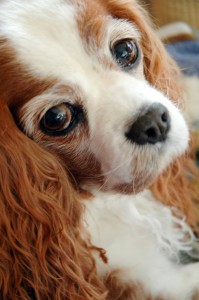
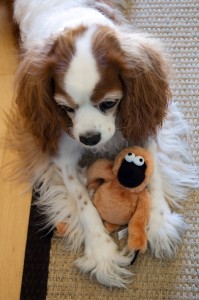
Within those categories are dogs who are bred for certain functions. Dogs like Dalmatians are bred to run all day, others like the working group’s Bernese Mountain Dogs were used in the Swiss Alps as farm dogs. Cavalier King Charles Spaniels, like my dog, Ollie, are toy dogs, bred to be companions first, and indifferent birding dogs second (the lords of the manor used them to flush birds, who knows why, with all that hair).
So what’s the problem? There isn’t one, if you do your homework. Sadly, too many people don’t.

Ollie the Cavalier
I ended up with a Cavalier because of size and temperament. I’m handicapped, and couldn’t go as far as an English Cocker needs, let alone many of the other breeds. In other words, I did my research to find a dog I could live with who could also live with me. Three dogs later, we’re doing just fine.
Other dogs are not. I know someone who adopted a shelter dog who clearly had herding blood in its background. This dog did what came naturally to herding dogs, who were bred to nip at the heels of cattle and sheep to keep them moving in the right direction. This dog nipped at its owners’ feet, scaring them since they were older and had stairs. They followed their veterinarian’s advice and euthanized him.
Tragic, shocking and unnecessary, if that’s the whole story. First, they should have gone to a shelter who could better guess what was in the dog’s breeding and advise them on what to expect; and second, they should have returned him to the shelter in hopes he could find another home. My opinion. Probably yours, too.
I also know plenty of people who bought dogs they thought were cute but did not fit their lifestyle. Hounds who were left home unattended all day and became sullen and snappish. Big breeds like Shepherds and Labradors and Golden Retrievers who lost their homes because they grew up untrained and couldn’t be managed (some of these breeds are puppy-like for three years or more, meaning early and prolonged training is essential). A friend who went to the shelter and brought home a large breed dog who destroyed her furniture, but who called me crying, asking what to do, and worked with a trainer I recommended (eight years later they are still a happy pair).
So how do you decide?
Check out the AKC site, as suggested. And head off this weekend to the dog show. Watch the dogs in the ring, attend the Meet the Breed groups both days, to learn about breeds that intrigue you, and visit the many booths that breed clubs staff to let you meet a dog and ask questions. These are people who love dogs, know their dogs, and want for you and the dog you choose (and who chooses you) to live happily ever after.
And have fun!
© 2017 Robyn M Fritz
 What do you do with your dogs?
 Seattle is a good place to live with dogs. Except maybe for this winter, when going out is more a matter of endurance than fun exercise.
 If you’re interested in competitive sports, check out a local training facility, and in particular the
  In late May 2003 I was running errands and suddenly detoured to stop at a local pet store and get some dog cookies. They had long fostered cats and kittens from a local cat rescue service, but I was astonished to hear birds chirping, and asked if they were now adopting out birds.
 Contrary to what some religious doctrines say, reincarnation happens. When it crosses species it isn’t inappropriate or a form of punishment, as mindsets that accept reincarnation sometimes imply. It’s simply the form the soul has taken to do its job for that lifetime—and an extremely advanced, old soul like the soul that has inhabited all my dogs, including my year-old son, Ollie, or the soul that became Grace the Cat, can do an awful lot.
 Grace the Cat adored being a house cat (quite a difference from Tweety the chicken, who lived outside and ended up as a weasel’s lunch). Like all my animals, Grace also explored multiple dimensions, working on her own and with me at dimensional portals, which allow different dimensions to interact without blowing things up (an inadequate but necessarily simple explanation). In other times and places she would have been called a “familiar,” but whatever the term, Grace was an energy amplifier. She essentially “upped” the frequency so that I could do part of my work, which is as an ambassador to the earth, working with land and weather systems.
 I learned my work included working with the planet and different dimensions years before I started my current public work. I kept quiet about it for a long time, sharing it with people who quietly showed up for training. I did it when I needed to, and very little of that is public.
 This goddess, Con Ni (yes I know her real name, but she likes this one), arrived on Tuesday, September 20, to tell me that Grace and I had one last job to do for the planet before her death, work Grace had already agreed to before Con Ni came to me. A good thing, that, because I’m not as altruistic as you’d think.
 Hurricane Matthew marching through the Caribbean and up the east coast was not a natural hurricane any more than the earthquake Grace and I altered. It had the same red energy threads and the same nasty people forcing it to their will. When I went to work with it, as Grace joined me from the afterlife, I saw that the manipulation would propel it well beyond anything we’ve seen as a Category 5, and it would go far inland.
 This week I had one of those “double-edged sword” days in my work. When I ask myself why I do what I do, and know I wouldn’t do anything else.
  Sometimes what animals say to us is surprising. I remember when a very ill cat told me he wanted to die: he really didn’t, as I could tell from his nuanced conversation (yes, you can pick up nuances telepathically), he really wanted to know what was wrong with him, what his person was doing about it, and what it would mean. Would he recover and be fine, or drag on and be miserable? Sadly, his person ignored the answers I offered, and, while the cat recovered, his journey to wellness would have been easier on both of them if his person had simply backed me up by explaining things. I learned from that to be careful who I worked with—because the human-animal bond as I live it, at home and at work, means that we listen to our animals, respond to them as intelligent equals, and bumble our way through life, together.
 mals and the Afterlife
 People debate reincarnation, multiple simultaneous lives, whether humans can be reborn as animals (or vice versa)—even whether animals can reincarnate. Others like me live with the truth: souls can do whatever they want, regardless of human dogma. Souls choose the form they need to do the job they chose before they incarnated, and if everything works out, they succeed. As we all know, though, once bodies, free will, and real life interact, it’s a free-for-all, anything-can-happen world.
 Murphy wasted no time dismantling everything I thought I knew about the world (which turned out to be a good thing). She was six months old when I noticed that her nuanced responses to people, animals, and the world around her were far beyond what we consider to be animal intelligence. The rest of it is the earthquake’s fault. On February 28, 2001, Murphy was curling up for a nap when she leaped up barking and snarling and dragged us out of our condo—about two minutes before Seattle was rocked by a 6.8 earthquake.
 Alki Fritz, Dec. 25, 2001 – Nov. 17, 2014.
 Do you ever wonder why you bother? Not just to get up, but to stay up when you know that mostly what you’ll get is hurt?
 I’m sharing this rambling note with you so you know that darkness comes to all of us, no matter how much we love, because in choosing to incarnate here we choose to experience organic life, and that means it will eventually end. But darkness doesn’t have to destroy us: we can choose how we meet it. Have you ever felt grief, worry, doubt, confusion, despair? Of course you have, because you are here. You are not alone. We all have something we have to deal with, like it or not, because we all bothered to love. It matters.
 This spring I was privileged to attend the death of a dear friend’s beloved cat, Sachi, who had terminal cancer and had reached the end of what she could tolerate. My friend, Reiki master and massage therapist Mary Van de Ven, had done everything possible to help Sachi, but the cancer was relentless.
 Oh, the best laid plans. The next morning it was pouring down rain and I got lost. As I was driving, my dad suddenly popped in.
 Nearly every week for the last two years I’ve received emails thanking me for the article I wrote about taking my beloved Murphy to the veterinary surgeon to discuss treating the cancer that would inevitably kill her. Most of these emails are private; many are also here on the blog